
*This article was written by Caroline Carrothers on behalf of the West Papua Human Rights Center.
Starting at dawn, in the highlands of West Papua, mist hangs low over the canopy, drifting between ancient trees that have stood longer than memory. Smoke rises slowly from cooking fires. The sound of footsteps travels differently here, softened by earth that has held generations. For those who live here, the forest is not a backdrop; it is where stories begin.
This is where the story of West Papua starts. Not with policy, or borders, or development plans, but with a relationship between people and the land. Nevertheless, today, across West Papua, this living world is being carved, mined, and militarized at a pace that is threatening the land and the very existence of its Indigenous peoples. This isn’t a mere environmental crisis, but a story of Indigenous survival in the face of erasure.
We Are Not Invisible
A generation of Indigenous Papuans has come of age during a period of rapid change. Many have watched forests cleared in areas where communities once gathered food, built homes, and passed down knowledge. Roads now cut through landscapes that were previously connected through customary systems rather than mapped through boundaries. New arrivals reshape towns and alter access to opportunity.
Despite this, the language that is often used to describe West Papua remains distant from the lived experience. The land is frequently framed as remote, underdeveloped, or available for transformation.
For those who live there, this framing is difficult to reconcile with reality.
West Papua is not empty: it is home to hundreds of communities whose lives are inseparable from the forests, rivers, and mountains that surround them. Said landscapes aren’t idle spaces. They are systems of life, memory, and responsibility.
As these changes accelerate, many young Papuans are working to ensure their presence, and their perspectives, aren’t overlooked.
What is West Papua?
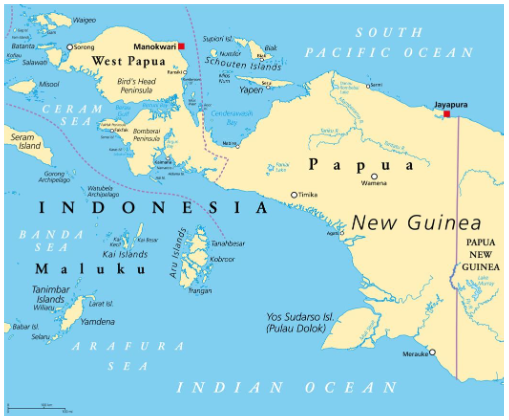
West Papua refers to the western half of the island of New Guinea, one of the largest and most ecologically rich islands in the world. Today, it is administered by Indonesia and divided into multiple provinces, bordering the independent state of Papua New Guinea to the east.
The region’s geography is striking. Dense rainforests stretch across vast lowlands, while steep mountain ranges dominate the interior. These ecosystems support extraordinary biodiversity, much of which remains understudied.
Equally remarkable is the region’s cultural diversity: more than 250 distinct groups live across this landscape, each with its own language and traditions. Many identify as Melanesian, sharing deep cultural ties with the wider Pacific. Social systems are closely tied to the land, which is governed through customary practices rather than formal ownership.
The political history, however, remains contested. After the end of Dutch colonial rule, control shifted to Indonesia and was formalized through the Act of Free Choice, a process widely criticized for its limited participation and coercive conditions. For many, this moment marked the beginning of an unresolved struggle over representation and autonomy.
Today, the region remains difficult for outsiders to access, contributing to limited international visibility despite decades of tension.
What Changes Look Like
The forests of West Papua are among the most intact in Southeast Asia. For generations, they have been managed through local knowledge systems that regulate hunting, farming, and conservation. Said balance is now shifting.
Change in West Papua is gradual, but its effects accumulate over time. It may begin with the construction of a road, followed by increased access to areas that were once difficult to reach. Forests that sustained communities for generations become sites of extraction. Land that was managed through customary practices is redefined through new systems of ownership and use.
Said transformations tend to be described in terms of progress. On the ground, they alter ecosystems and disrupt long-standing relationships between people and their environment. When the forests are cleared, the impacts extend beyond what is immediately visible. Food sources shift, water systems are affected, and cultural sites may be lost. The consequences are felt in the everyday life of these Indigenous Papuans.

Customary lands have been converted into palm concessions. The Trans-Papua Highway has increased access to remote areas, accelerating logging and land conversion. Meanwhile, one of the world’s largest mining operations, run by Freeport-McMoRan, continues to extract vast resources while nearby populations report environmental and social impacts.
International standards emphasize the importance of “free, prior, and informed consent.” In practice, those affected often have little influence over decisions that reshape their surroundings.
Shifting Demographics
Change is also visible in the composition of the towns and cities. Over several decades, migrations have brought large numbers of newcomers into the region. In urban centers, Indigenous Papuans are increasingly outnumbered. This transformation affects access to employment, education, and political representation. It also has implications for cultural continuity.
As communities move away from their ancestral lands or lose access to them, languages and traditions face growing pressure. Systems that once governed land use and social life weaken when they are no longer rooted in place.
Similarly, disparities in healthcare, education, and economic opportunity persist. Findings from organizations such as Amnesty International and Human Rights Watch point to ongoing concerns about discrimination and the treatment of those who speak out. What emerges from this is not a single moment of loss, but a gradual narrowing of space in which communities can sustain their identity.